Phone:
(949) 394 6355
Physical address:
2941 S Main St. Unit A, Santa Ana, CA, 92707
Phone:
(949) 394 6355
Physical address:
2941 S Main St. Unit A, Santa Ana, CA, 92707
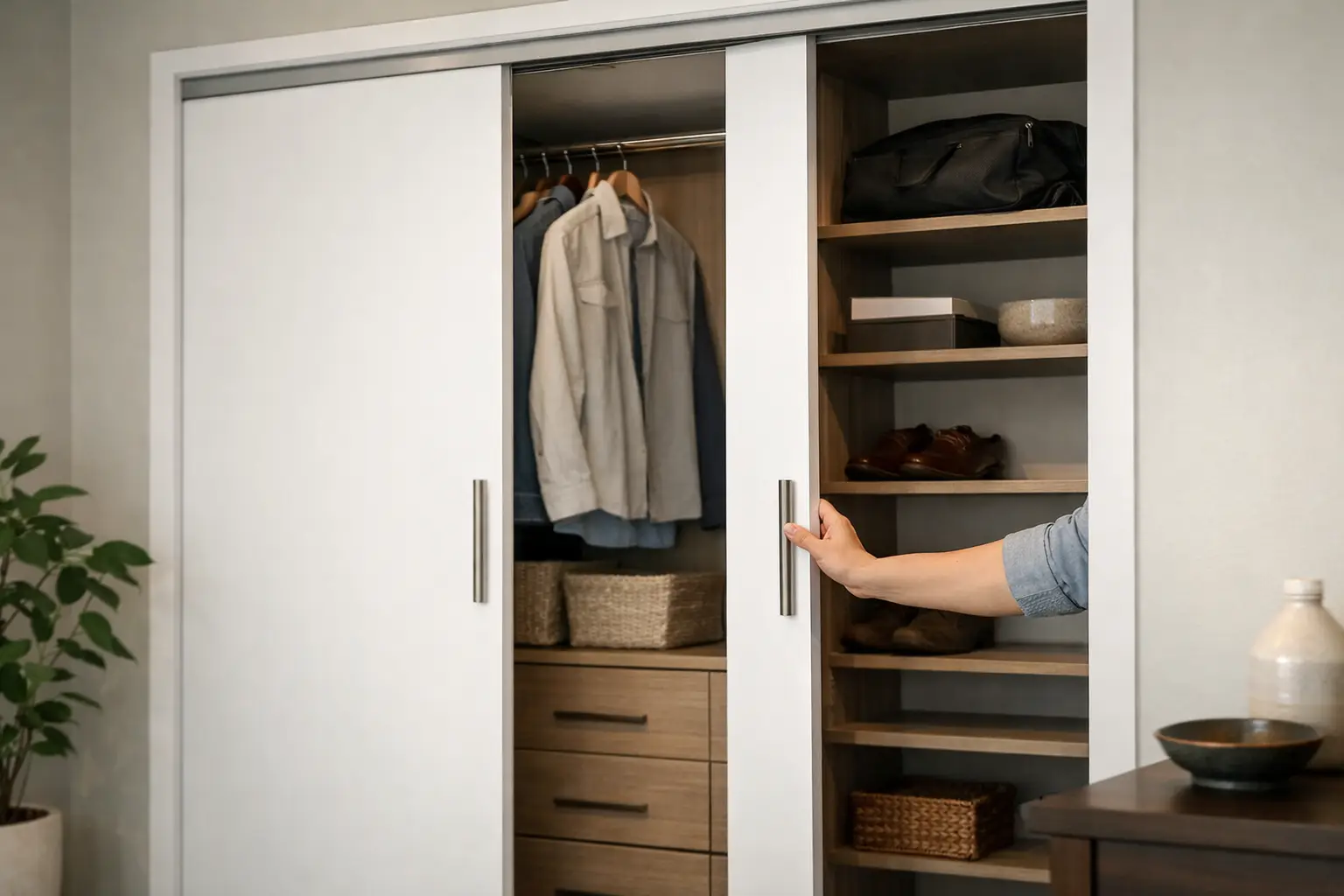
Standard bypass doors always block half the closet. Full-extension bypass systems let panels stack out of the way. Here's how they work and when they're worth it.
Standard sliding closet doors have one built-in frustration: one panel is always in front of part of the closet. If you’re constantly sliding doors back and forth to reach a dresser, shoe rack or the far end of the rod, a full-extension bypass system is worth a look.
On a standard two-panel bypass, the panels overlap and you can only ever open half the opening. Full-extension systems use extra track lanes, typically three panels on a triple track, so panels can stack behind each other. The result is about two-thirds of the closet open at once, and the doors still never swing into the room.
Not every closet needs it. On a narrow opening, a standard two-panel bypass is often the better value, and bifolds still work well where you want the full width open.
Full-extension systems come in framed mirror, frameless mirror, frosted or painted glass and solid panels. Black, white, bronze and silver frames let you match the room’s hardware. Mirror panels are especially popular because they brighten the bedroom and give you a full-length mirror.
A triple track needs more depth at the header than a double track. We confirm the opening can support it during measurement.
With three panels, overlaps and gaps multiply. The opening must be measured at multiple points so the panels meet evenly and the top track sits perfectly level. We build every system to the measured opening.
Three heavy panels put real load on rollers and track. Look for tandem rollers, rigid aluminum or steel track and a bottom guide that keeps each panel in its lane. Our McCoy systems, for example, use commercial-grade tandem rollers on stainless steel track.
Choose finishes that work with your trim, flooring and fixtures, and think about what mirrors will reflect. A well-planned system looks built-in, not added on.
In most homes, yes. Full-extension access is usually achieved with a three-panel triple-track system.
Usually. We replace the double track with a triple track and install three custom panels, typically in one day.
New sliding doors typically run $550–$850 per panel installed, with a 3 to 5 year manufacturer warranty and our 1-year labor warranty.
Ready to reach your whole closet? Call or text (949) 394-6355 or book a free in-home estimate in Orange County.
Need more access than bypass doors allow? Learn more about our triple-track closet doors.